What 1,590 skills reveal about the Australian primary curriculum
We machine-matched every skill on the Learning Map against the 614 Australian Curriculum v9 content descriptions for Foundation–Year 6. What maps is reassuring. What doesn't is the interesting part.
The Learning Map is built on the open Marble Skill Taxonomy: 1,590 fine-grained skills covering the primary years, each with a plain-language description and a parent-facing "try this" prompt, connected by 3,221 prerequisite links. The taxonomy grew out of UK/US practice — so before trusting it for Australian families, we asked the obvious question: how well does it actually fit the Australian Curriculum?
(A method note before the numbers: every match is a candidate alignment — machine-suggested, confidence-scored and unreviewed (v0.1). The method page has the full pipeline and its limitations, and the v0.1 crosswalk was matched against 475 of the 614 content descriptions, so "no match" rates are upper bounds. Every specific gap below was re-verified by word search against the complete 614-record set.)
Coverage: the core subjects fit, the edges don't
Of 1,590 skills, 1,007 (63%) received at least one candidate AC9 match — 233 at high confidence, 461 medium, 313 low. Another 120 sit beyond Year 6, 18 land in ACARA's General Capabilities, and 445 skills (28%) found no F–6 home at all.
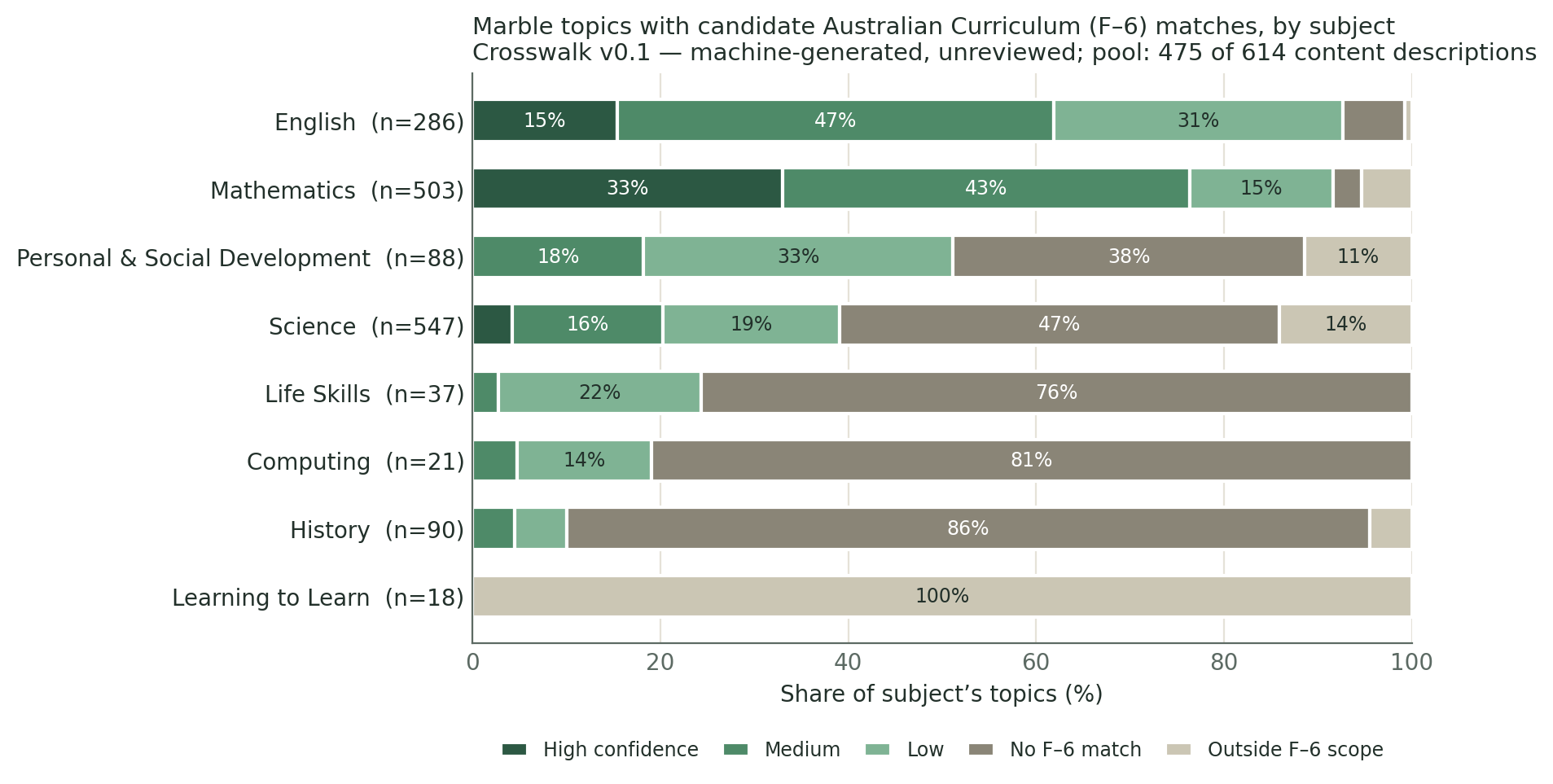
The subject split is stark. Mathematics is the best-aligned subject on the map: 92% of its 503 skills found a candidate match, exactly a third at high confidence. English is close behind at 93%. At the other end, only 10% of the 90 History skills and 19% of the 21 Computing skills found any F–6 home — and Science, the map's largest subject at 547 skills, matched only 39%.
AI literacy is a real hole
17 of the map's 21 Computing skills found no match — how voice assistants work, machine learning basics, recommendation systems and filter bubbles, deepfakes and AI-generated content. And this one is not an artefact of the matching pool: none of the 614 F–6 content descriptions mentions artificial intelligence, machine learning or anything adjacent. The F–6 Digital Technologies curriculum covers algorithms, data and digital systems — but AI as a thing a primary child should understand simply isn't there yet. Whatever you think young children should learn about AI, right now the Australian answer is: it's not on the official map.
History starts earlier elsewhere
77 of 90 History skills are unmatched, and 48 of them start at age 7 or younger — a dense cluster of ancient-Egypt content pitched at ages 5–7: discovering Tutankhamun's tomb, everyday life in ancient Egypt, the pyramids and the Great Sphinx. The words "ancient" and "Egypt" appear in none of the 614 F–6 descriptions: Australia's HASS curriculum keeps early-years history local and personal, and defers ancient civilisations to Year 7. Neither approach is wrong — they're two different bets on when children can handle deep time. (Plenty of five-year-olds vote with their bookshelves.)
Australian science is conceptual; children are encyclopedic
Science accounts for 256 of the 445 unmatched skills — famous dinosaur species, nocturnal animals, rainforest creatures, animal record-holders. ACARA's 77 Science content descriptions describe concepts and inquiry skills ("living things have life cycles"), not the interest-led factual topics children actually binge on. These are different layers of the same subject, and the map deliberately carries both.
Two smaller patterns
Grammar is named elsewhere, described here. The map codes the present perfect tense and the subjunctive mood as discrete skills; neither term appears anywhere in the 614 descriptions. English still matches at 93% overall — the gap is in explicit grammatical labelling, not literacy coverage. If UK-trained tutors and Australian classrooms sometimes talk past each other, this is part of why.
Everyday economics is thin. 28 of 37 Life Skills skills — coin values, saving, entrepreneurship, supply chains — found no F–6 match, though "needs and wants" does appear in HASS economics, so this cluster's true gap is smaller than v0.1 suggests.
Where both curricula teach the same thing, they agree on when
For the 233 high-confidence matches we compared the map's typical age with the ACARA year level. They agree closely: a median offset of half a year, with two-thirds of matches within ±1 year.
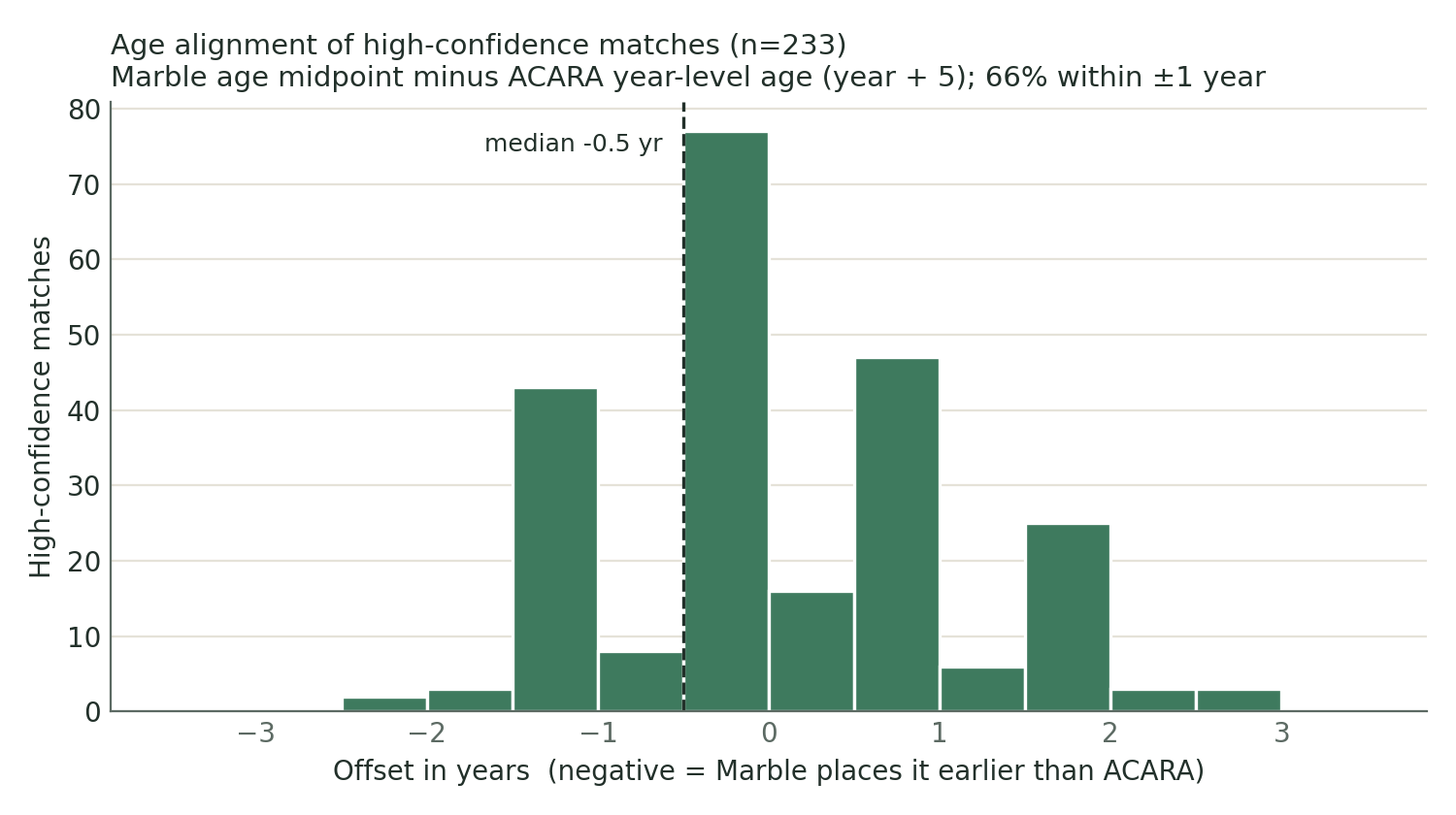
So the disagreements above aren't noise from a badly calibrated ruler — where the two curricula genuinely overlap, they broadly agree on timing. The gaps are real differences in what each thinks belongs in primary school.
What does this actually mean?
If you're a parent: when your six-year-old is obsessed with Tutankhamun, or asks how the voice assistant knows things, school probably isn't covering it — and that's a scope choice, not a verdict on your child. The map keeps those skills anyway, each with its prerequisite chain and "how to tell they've got it" signs, because children don't check the curriculum before getting curious.
If you homeschool: "no match" doesn't mean "not worth teaching" — and a match doesn't mean compliance. Treat every code on this site as a lead to check against the official curriculum, never as a tick. (The alignments are machine-suggested candidates, v0.1, unreviewed.)
If you teach: the unmatched lists are a ready-made bank of extension material — the things curious kids ask about that no content description names, from deepfakes to the subjunctive.
If you build ed-tech: UK/US-shaped content libraries will misfit Australian classrooms in exactly these places — early ancient history, explicit grammar labels, AI literacy. The open crosswalk quantifies that misfit code by code.
Explore it yourself
Every skill mentioned here links to its page on the map, with its prerequisite chain and candidate curriculum codes. The full datasets — including the crosswalk with every match, score and status — are on the data page, and the machine-readable Australian Curriculum dataset lives at github.com/curiousape-ai/acara-v9-f6-json. Corrections welcome: the whole point of publishing candidate alignments openly is so people who know better can fix them.
All curriculum alignments referenced above are candidate alignments — machine-generated and unreviewed (v0.1), not official mappings. How the map was built →